

Chesapeake Health Department Alerts Deep Creek Residents to Rabid Raccoon
October 21, 2026
Media Contact: Kimi Stevens, kimi.stevens@vdh.virginia.gov
Chesapeake Health Department Alerts Deep Creek Residents to Rabid Raccoon
Public Urged to Avoid Contact with Wild Animals
CHESAPEAKE, Va. – The Chesapeake Health Department has confirmed a case of rabies involving a raccoon. The raccoon was found on Firman Street in the Deep Creek area of Chesapeake. The raccoon was observed with visible injuries on Wednesday, October 14. No known human exposures to the raccoon have been reported.
“Although a raccoon may appear healthy, they often carry diseases including rabies,” said acting health department director Jon Richardson. “For safety’s sake, contact a professional animal services provider or animal control if you encounter sick or injured wildlife.”
Rabies is commonly found in Virginia in wild animals, such as raccoons, skunks, and foxes. Through the third quarter of this year, 127 raccoons, 59 skunks, 36 bats, 32 cats, and 20 foxes tested positive for rabies in the Commonwealth. In Chesapeake, four rabid animals have been reported since the beginning of the year.
Rabies is caused by a virus that attacks the nervous system and is lethal if proper medical care is not given following an exposure to the virus. The most common source of exposure to rabies is a bite by a rabid animal. Rabies may also be transmitted by saliva from a rabid animal coming into contact with open wounds, the mouth, eyes or nose.
Virginia law requires all dogs and cats four months of age and older be vaccinated for rabies by a licensed veterinarian. Vaccinations must be kept current.
All mammals, including humans, can get rabies. Symptoms may appear as early as a few days or as long as several months after exposure.
Actions you should take to prevent rabies in people and pets include:
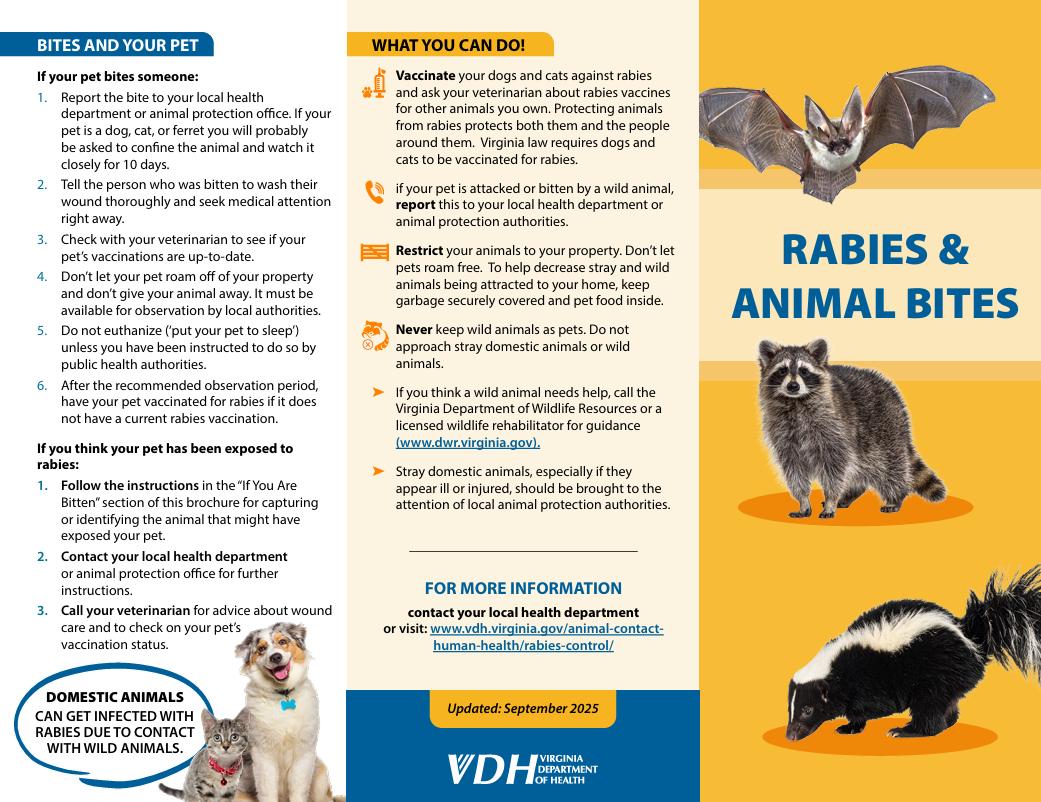
- Be sure that your pets are up to date on their rabies vaccinations.
- Avoid contact with wild animals or stray animals.
- Do not feed stray animals. Avoid wild animals, especially raccoons, bats, foxes, and skunks. Feed your pets indoors and do not let them wander.
- Teach children to avoid contact with wild animals and unfamiliar pets.
- Do not handle sick, injured or dead animals. Contact the Virginia Department of Wildlife Resources (DWR) or a licensed wildlife rehabilitator if you have concerns about sick or injured wildlife.
- Keep wild animals out of homes by capping chimneys with screens and blocking openings in attics, cellars and porches. Ensure trash cans have tight-fitting lids.
- Do not try to trap or handle stray and wild animals. If a bat is found indoors and may have had contact with someone, do not release it. Call your local animal control officer or health department to determine if the animal should be picked up and tested for rabies.
- Report all bites to people to the local health department for investigation.
If you are bitten by a wild or stray animal, do not panic. Wash the wound(s) thoroughly with warm soapy water and contact animal control, your doctor or the health department for further recommendations.
For more information, please contact the Chesapeake Health Department or visit the Virginia Department of Health’s rabies website or the Centers for Disease Control and Prevention’s rabies website.
# # #
Legal Disclaimer:
EIN Presswire provides this news content "as is" without warranty of any kind. We do not accept any responsibility or liability for the accuracy, content, images, videos, licenses, completeness, legality, or reliability of the information contained in this article. If you have any complaints or copyright issues related to this article, kindly contact the author above.
