

Paying Psychiatrists More Could Be the Cheapest Fix for America’s Mental Health Crisis
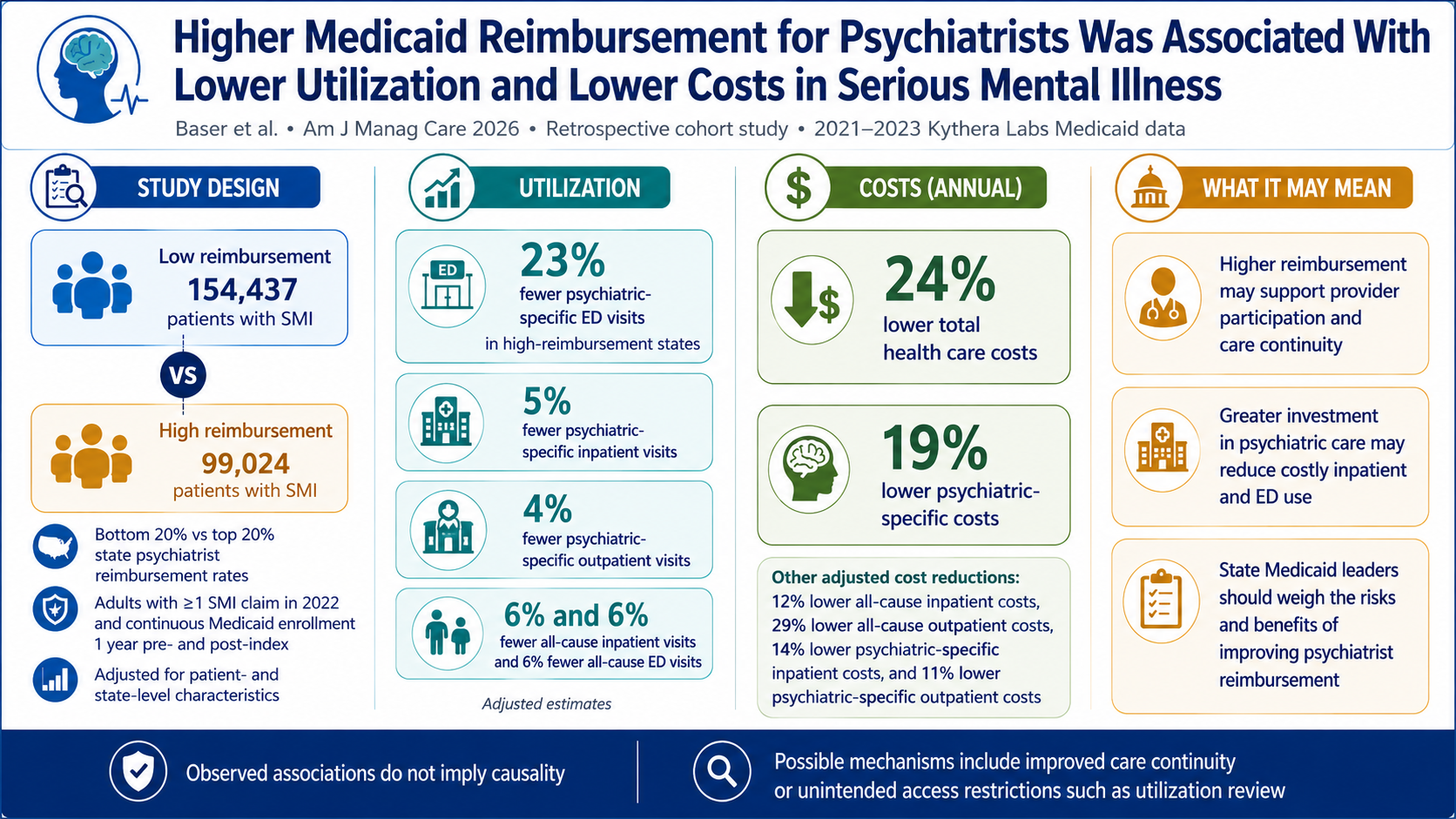
Higher Medicaid reimbursement rates for psychiatric services were associated with reduced health care resource utilization and lower annual costs among Medicaid patients with serious mental illness, according to a retrospective cohort study of 2021–2023 K
Higher Medicaid reimbursement for psychiatrists was associated with lower utilization and lower costs among patients with serious mental illness.
Researchers led by Professor Onur Baser of the Graduate School of Public Health at the City University of New York (CUNY) and Columbia Data Analytics, using Kythera Labs Medicaid data, analyzed more than 250,000 Medicaid patients diagnosed with schizophrenia, bipolar disorder, major depressive disorder and related conditions across all 50 states from 2021 to 2023. Patient outcomes were compared among states in which psychiatrists were paid the most for common services vs paid the least — a gap that spans a factor of more than five between the highest- and lowest-paying states.
Key Findings
After controlling for patient demographics, comorbidities and state-level policy factors, the study found that patients in higher-reimbursement states experienced significantly better outcomes:
• 23% fewer psychiatric emergency department visits
• 24% lower overall annual healthcare costs
• 19% lower annual psychiatric-specific costs
• 5% fewer psychiatric inpatient admissions
• 6% fewer all-cause inpatient and emergency department visits
• 12–29% lower inpatient and outpatient costs across all-cause and psychiatric categories
The study also identified complementary state-level levers associated with better outcomes, including Medicaid expansion, Medicaid Health Homes for mental illness and substance use disorder, higher per-capita Substance Abuse and Mental Health Services Administration (SAMHSA) block grant funding, and greater availability of behavioral health providers.
Why It Matters
The mechanism is straightforward economics. Medicaid currently reimburses psychiatrists at approximately 81% of the rate of other physicians for equivalent services, and psychiatrist acceptance of Medicaid patients has been declining for years. When reimbursement lags — as it does in many states — fewer clinicians participate, appointments become scarce, and patients fall out of care until a crisis forces the system to spend far more on an emergency room or inpatient bed.
The study estimates that the 20 most frequently billed psychiatric procedures account for about 27% of total psychiatric costs. A 20% increase in reimbursement for those services would directly affect only about 5.5% of total Medicaid spending — yet the study’s findings suggest it could drive a 24% reduction in total healthcare costs per patient through reduced crisis utilization.
The findings arrive as state Medicaid programs face tightening budgets and rising mental health demand. The authors are careful to note that the observed associations may not establish causality — differences in managed care arrangements, utilization review practices, and care delivery models across states could also contribute. But the pattern is consistent across multiple sensitivity analyses, including propensity score matching and falsification testing.
About the Study
Baser O, Waters HC, Yapar N, Samayoa G, Han X, Freedman D, Isenman L, Patel R. “The Effect of Medicaid Reimbursement for Psychiatrists on the Health Care Burden of Serious Mental Illness.” Am J Manag Care. 2026;32(6):294–e300.
The study was funded by Otsuka Pharmaceutical Development & Commercialization, Inc. Data analysis was conducted by Columbia Data Analytics using Kythera Labs Medicaid claims data covering more than 44 million patients and 900 million claims from 2021 to 2023.
About Columbia Data Analytics
Columbia Data Analytics is a New York-based health economics and outcomes research firm specializing in real-world evidence generation, large-scale claims data analysis, and policy-relevant research across therapeutic areas. The firm partners with pharmaceutical companies, academic institutions and policy organizations to design and execute retrospective and prospective studies using administrative claims, electronic health records and linked data sources. Columbia Data Analytics has particular expertise in mental health, neurology, and complex chronic conditions, and is committed to producing high-quality evidence that informs clinical practice and health policy.
Elizabeth Vivier
Columbia Data Analytics
+1 332-264-0244
email us here
Visit us on social media:
LinkedIn
Legal Disclaimer:
EIN Presswire provides this news content "as is" without warranty of any kind. We do not accept any responsibility or liability for the accuracy, content, images, videos, licenses, completeness, legality, or reliability of the information contained in this article. If you have any complaints or copyright issues related to this article, kindly contact the author above.
