

EuroVASC 2026: 72% Back Checking Radial Artery Patency Before Discharge
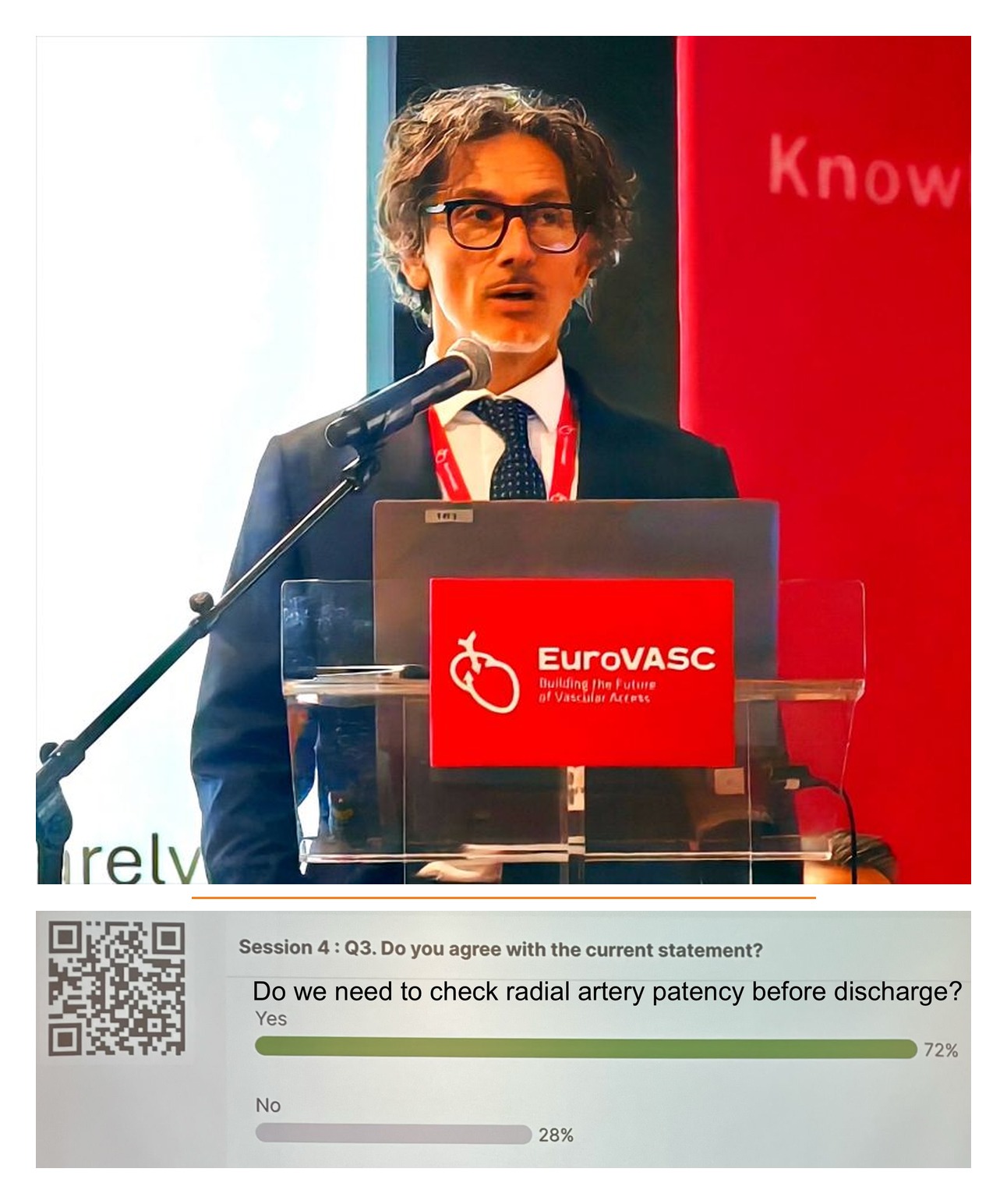
Dr. Giovanni Amoroso, Medical Director and Co-Founder of IDAHealth Inc., delivering the split lecture “Maintaining is enough?” at EuroVASC 2026. During the session, 72 percent of participants agreed that radial artery patency should be routinely assessed
A clear majority now wants patency verified before discharge, reflecting a shift to access preservation addressed by IDAHealth's Dr. Giovanni Amoroso.
After every wrist-access heart procedure, the artery is compressed for hours. The goal of that compression is dual: stop the bleeding while keeping the artery open. Doctors call this Patent Hemostasis. Every cardiology society recommends it. No device measures whether it is actually achieved.
That gap is the starting point for IDAHealth. Patent Hemostasis is two requirements held simultaneously. Dedicated compression devices solved the bleeding-control half in 2007. The patency half, keeping the artery open, is still delivered by intermittent manual checks. For years the femoral artery served as a fallback when a radial artery was lost. As transradial access has become the default, at roughly 70 percent of procedures globally and climbing past 18 million procedures within five years, that fallback is disappearing, and the cost of the unmeasured half is now visible.
Radial artery occlusion runs at a 13 percent mean across 41 studies and roughly 30,000 patients (Khalid et al. 2024), within the 5 to 15 percent range reported in the 2026 position paper of the German Society of Cardiology (Breitbart et al., DGK 2026). Occlusion is usually silent at the moment it occurs, because the hand keeps a second blood supply through the ulnar artery, yet transradial access is not free of under-recognized, potentially disabling complications (Wiper et al., 2020). The cost of a lost radial artery is deferred, not absent. Patients will need an open radial artery for a subsequent procedure, and discover the loss only when that artery is needed again.
At today's volume of about 14.5 million transradial procedures a year, that means roughly 1.9 million radial arteries are silently lost annually. Half of these patients will need that artery back. Some within a year, when staged PCI requires re-entry through the same site. The rest later, when the radial is the preferred second conduit for coronary bypass surgery, or the access path for arteriovenous fistulas in dialysis.
Where Patent Hemostasis has been confirmed continuously rather than checked intermittently, results follow. In the largest published prospective dataset, mean hemostasis time fell from 190 minutes to 66 minutes (Takamatsu et al. 2023). IDAHealth will replicate this in its own trials, but the clinical evidence already exists, and clinicians are asking for a tool that delivers it.
IDAHealth is building the category it calls Guided Compression: real-time, objective, data-generating monitoring of radial artery flow during the compression that follows every transradial procedure. Its first product, IdaFlo TR, is a single-use wristband sensor that attaches alongside any existing compression band and shows a real-time green, yellow, or red flow signal. It turns any compression band into a guided, measured device, the way continuous glucose monitors replaced finger-stick testing. The sensor is powered by IDASense, IDAHealth's proprietary conductive elastomer sensor platform.
IdaFlo TR pairs a reusable reader with a single-use sensor, and each procedure produces a continuous, objective record of the compression itself, a dataset that does not exist today. IDAHealth's patent family is granted in the United States, the European Union, Japan, China, and India, with protection extending toward 2040. The company was selected to the BDMT Global Top 40 in 2026, and a first European clinical pilot cohort is committed across leading centers in the Netherlands, Belgium, the United Kingdom, and Germany.
IDAHealth Inc. is a medical device company creating the category of Guided Compression: real-time, objective monitoring of radial artery flow during the post-procedural compression that follows transradial catheterization. Its first product, IdaFlo TR, is powered by the IDASense conductive elastomer platform and works alongside any existing compression band. IDAHealth is a Delaware C-Corporation with operations in the Netherlands.
David L. Camp, Jr
IDAHealth Inc.
+1 954-806-2962
info@idahealth.us
Visit us on social media:
LinkedIn
Legal Disclaimer:
EIN Presswire provides this news content "as is" without warranty of any kind. We do not accept any responsibility or liability for the accuracy, content, images, videos, licenses, completeness, legality, or reliability of the information contained in this article. If you have any complaints or copyright issues related to this article, kindly contact the author above.
